

9 min read
Improve your operations and grow your business with resources and best practices from BBSI's business consultants.

Workers' comp can look simple from a distance: buy a policy, report injuries, move on. In reality, coverage rules, employee classifications, claims, OSHA obligations, and premium calculations can turn it into a much bigger operational issue.
In these workers' comp FAQs, you’ll learn:
- What workers' comp generally covers
- When businesses are required to carry it
- How premiums, class codes, and X-Mods work
- What to do after an employee is injured
- How employers can reduce workers' comp costs and risk
It all starts with understanding what workers' comp actually does and where its protections begin and end.
What Is Workers' Comp & What Does It Cover?
The basic concept of workers’ compensation is straightforward, but what qualifies as a claim and what benefits are available depend heavily on state law.
What is workers' compensation?
Workers' compensation is insurance that may cover an employee's medical treatment, partial wage replacement, disability benefits, rehabilitation, and death benefits for surviving dependents after a qualifying work-related injury or occupational illness.
What kinds of injuries does workers' comp cover?
Coverage can include sudden accidents, such as a fall or machinery injury, as well as some occupational illnesses or conditions that develop over time because of workplace exposure or repetitive tasks.
Does workers' comp cover every workplace injury?
No. An injury that occurs at work does not automatically make it compensable. Eligibility depends on the facts and applicable state law. An OSHA-recordable injury is not automatically a compensable workers' comp claim, and vice versa.
What’s the difference between an OSHA-recordable injury and a workers’ comp claim?
An OSHA-recordable injury and a workers’ comp claim are not the same thing. OSHA uses its own criteria to determine whether a work-related injury or illness must be recorded. Workers’ comp claims are evaluated separately based on applicable state law. That means an injury can be OSHA-recordable without necessarily qualifying for workers’ comp benefits, and vice versa.
Does My Business Need Workers' Comp?
This is one of the most important workers' comp FAQs because there is no universal national threshold. Whether coverage is required depends on state law, industry, employee count, ownership structure, and sometimes where employees actually perform their work.
Is workers' comp required for every business?
No, because requirements vary significantly by state. For example:
- California: Employers with at least one employee generally need coverage.
- Florida: Non-construction employers generally need coverage at four employees, while construction employers generally need it with one.
- New York: Coverage is required for virtually all employers.
- Texas: Most private employers may choose whether to carry workers' comp, although exceptions and other obligations apply.
Check your local rules, or consult with an expert, for guidance on your state.
Do part-time or seasonal employees count?
They can. Part-time or seasonal status does not automatically exempt a worker from workers’ comp coverage, and some states count those employees when determining whether a business has reached a coverage threshold.
What about independent contractors?
A 1099 form does not automatically define the need for comp coverage. Workers' comp classification depends on state law and the actual working relationship, not just the label attached to the worker.
For remote and multi-state teams, the safest approach is to review requirements in the states where employees perform work.
How Much Does Workers' Comp Cost?
There is no standard workers' comp price because premiums are built around the specific risks and claims history of each business. Understanding these cost drivers can help owners spot where inaccurate payroll, classifications, or claims activity may be increasing expenses.
What determines workers' comp premiums?
Premiums are generally influenced by:
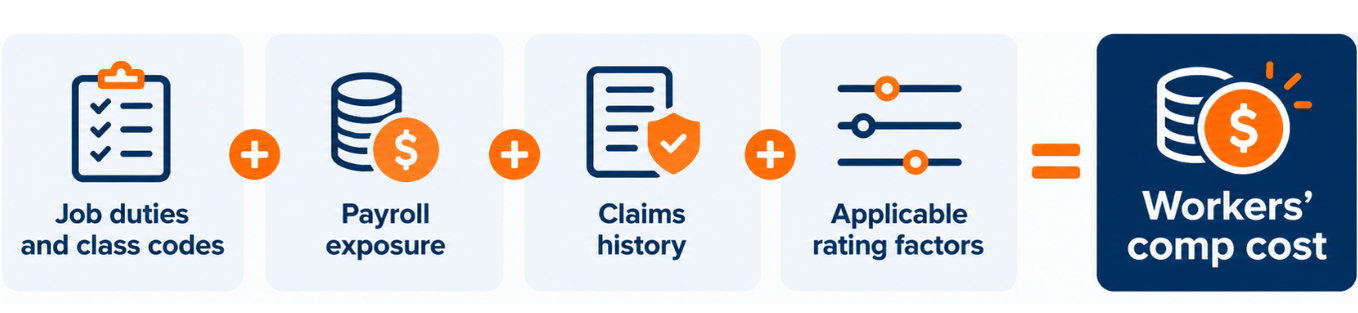
That means two companies with similar headcounts may pay very different rates if their employees perform different kinds of work or have different loss histories.
What is a workers' comp class code?
Class codes group jobs according to their duties and level of risk. For example, a receptionist and a roofer each have different class codes because their jobs present very different risk exposures.
If duties change but the class code does not, employers can run into pricing discrepancies or audit surprises, which makes accurate code classification important.
What is an X-Mod?
An experience modification factor, or X-Mod, compares an employer’s workers’ compensation loss experience with the expected losses for similar businesses. A rating of 1.00 generally represents the expected level of losses, while a lower or higher rating can contribute to lower or higher workers’ comp premiums.
The rating system used depends on the state. Many states use the National Council on Compensation Insurance (NCCI), while others have independent state rating bureaus that calculate experience modifications under their own rules. That’s why X-Mod calculations and requirements can vary depending on where a business operates.
The costs can be substantial: National Safety Council data using NCCI figures puts the average workers' compensation claim cost for 2022-2023 accidents at $47,316.
That is why cost control depends on more than simply shopping for a cheaper policy.
What Should I Do When an Employee Gets Hurt at Work?
When an injury happens, the first few hours are critical. A clear response process can help the employee get care quickly, keep documentation organized, and prevent missed reporting requirements from turning one incident into several problems.
What should I do first after a workplace injury?
Start with medical attention for the injured employee, then document what happened as soon as is practical. From there:
- Notify the appropriate workers' comp or claims contact.
- Complete any required state forms or reporting.
- Determine whether separate OSHA reporting or recordkeeping requirements apply.
- Stay in contact with the employee throughout recovery and return-to-work planning.
Deadlines can vary significantly by state. In California, for example, employers generally must provide or mail a DWC-1 claim form within one working day after learning of a work-related injury or illness.
Does filing a workers' comp claim satisfy OSHA requirements?
No. Workers' comp and OSHA are separate systems.
For mild injuries, you may need to add the incident to your OSHA injury and illness records. This generally applies when an employee needs medical treatment beyond first aid, misses work, has work restrictions, or is transferred to another job because of the injury. OSHA provides guidance to help employers determine which injuries need to be recorded.
More serious incidents have separate reporting requirements. Under federal OSHA rules, employers generally must report a work-related fatality within 8 hours and an inpatient hospitalization, amputation, or loss of an eye within 24 hours. State Plan requirements may differ.
How Can Employers Reduce Workers' Comp Costs and Risk?
Workers' comp cost control starts long before a claim is filed. Employers can influence both risk and future costs by tightening the processes around classification, safety, injury response, and return-to-work.
Can business owners actually influence workers' comp costs?
Yes. Key levers include accurate payroll and class codes, workplace safety programs, prompt injury reporting, active claims follow-up, and transitional or return-to-work programs when medically appropriate.
That matters even when overall claim frequency improves. NCCI reported that lost-time claim frequency fell 2% in 2025, while medical and indemnity severity each increased 4%.
Can a PEO help with workers' comp?
A PEO can help coordinate payroll, classifications, safety programs, claims support, and return-to-work processes while helping employers stay on top of state-specific requirements.
The employer still has important responsibilities, but a more coordinated system can make workers' comp much easier to manage.
Bottom line: workers' comp cost control starts before an injury happens and continues until the employee safely returns to work.
Get Better Answers to Your Workers' Comp FAQs With BBSI
Workers' comp touches far more than insurance. Coverage requirements, payroll accuracy, class codes, safety practices, claims response, and return-to-work planning can all affect both compliance and cost.
That is why a more coordinated approach matters. BBSI can support employers with pay-as-you-go workers' comp, class-code and X-Mod guidance, workplace risk assessments, safety consulting, 24/7 nurse triage, claims coordination, and return-to-work support for injured employees.
If your own workers' comp questions are getting harder to answer as your business grows, connect with your local BBSI representative to review your current approach and identify where stronger support could make a difference.
Quick Summary
Workers' comp can be complicated by state-specific coverage rules, employee classifications, claims procedures, OSHA requirements, and premium factors. This blog answers common workers' comp FAQs and explains how employers can better manage coverage, costs, workplace injuries, and risk.